The phone rings while you’re already helping a customer. You can’t answer both people at once. Later, you notice three missed calls and wonder how many opportunities you’ve lost.
That’s usually when the thought appears: “Maybe I need an AI receptionist.”
I understand the appeal. Somebody answers every time, even while you’re busy. It sounds like the problem is solved.
But why are missed calls hurting the business? Is it because callers need an immediate conversation? Because nobody knows who should call back? Or because urgent requests aren’t distinguished from routine ones? Those are very different problems.
A plumber can’t answer from under a sink, and stopping work every time the phone rings isn’t realistic. The real cost appears when a caller has no idea whether anyone will respond, or an urgent message gets lost among routine inquiries.
So yes, your frustration makes sense. But a better response process and an AI receptionist are not the same purchase. I’d want to understand what callers are missing before deciding which one you need.
Why answering a call isn’t the same as helping a customer
An AI receptionist can answer calls, handle routine questions, collect information, and sometimes help schedule appointments. That can be valuable.
The important part isn’t whether a friendly voice picks up. It’s whether the caller gets something useful, and whether your team knows what to do next. Otherwise you’ve improved the greeting and left the original problem untouched.
Consider a small plumbing company. One person calls because their kitchen faucet is dripping. Another needs to know whether the business serves their neighborhood. A third has water coming through the ceiling.
Those are three very different situations. The first may need a routine appointment. The second may only need information. The third needs urgent attention from somebody who can actually help.
A system that treats all three calls as ordinary booking requests may sound professional without being particularly useful.
And that is where I become cautious about choosing the technology before understanding the problem.
Why callers often need certainty more than conversation
Think about the last time you contacted a business and got no answer. What bothered you more: the absence of a sophisticated conversation, or not knowing whether anybody would get back to you? Most customers are looking for something very ordinary: reassurance that their request has been received and will be handled.
They want to understand what happens next. And they don’t want to repeat the same information three times.
A friendly AI voice might accomplish some of that. But so might a reliable callback process.
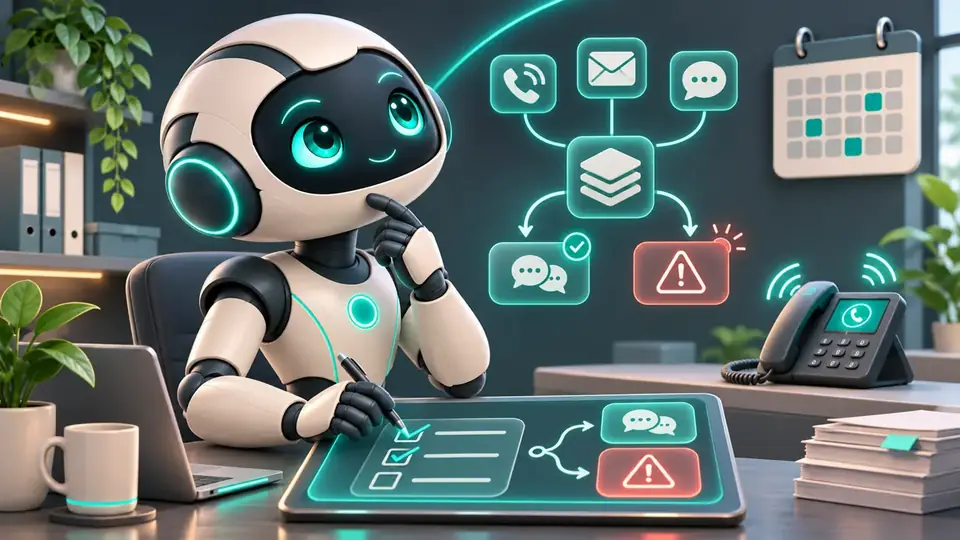
For example, a missed-call acknowledgment could give the caller a straightforward way to provide the service they need, their location, and whether the request is urgent.
The business then has something more useful than a mysterious number in its call history. It has an actionable inquiry.
That doesn’t require an elaborate conversation with artificial intelligence. It requires a process that somebody has thought through.
Why an urgent call changes the decision
Not every missed call has the same consequences. Think of a veterinary clinic after hours. One caller wants to reschedule a routine vaccination, another has a question about collecting a prescription, and a third says their pet is struggling to breathe. A single generic booking script cannot responsibly handle all three. That’s why I care about escalation before choosing a talking tool.
The challenge isn’t simply answering the telephone. It’s distinguishing situations that need immediate intervention from those that can safely wait.
For that reason, I would start with the company’s actual emergency procedures, responsibilities, and escalation rules.
When a call needs human intervention
The urgent cases need a reliable human response and appropriate emergency instructions, not an AI system improvising decisions about safety.
When a simple process is enough
Routine issues, on the other hand, may benefit from structured information collection and automatic confirmation.
There is no good reason to make the same person answer every ordinary request manually when a dependable process could collect the relevant details.
But there is also no good reason to hand critical decisions to AI merely because the technology exists.
The goal is responsiveness and reliability. Not the highest possible level of automation.
When AI becomes the right choice
There are situations where an AI receptionist makes sense.
A business might receive enough calls that ordinary staff cannot keep up. Callers might ask the same questions repeatedly. The company might have well-defined services, availability rules, and booking processes.
In that environment, AI may help provide useful answers and reduce interruptions. But several things need to be true.
The AI must have accurate information. It must understand when it cannot answer. It must hand off appropriately.
And the business must know what happens when the conversation ends. That last point is particularly important.
An AI system can collect a customer’s name, summarize their problem beautifully, and create a CRM record. Wonderful.
But if nobody follows up, what has really improved? You’ve simply created a more sophisticated way to lose an opportunity.
Why I’d fix follow-up before buying the voice
I wouldn’t start by purchasing a receptionist service. Why commit to another monthly cost before finding out whether the missed calls are mostly simple questions, callbacks, or genuinely complicated conversations? That is part of finding the real friction in a business.
For a small home-service company, I might recommend a missed-call notification, a useful acknowledgment, and a clear callback responsibility.
For a veterinary practice, I’d prioritize clear information for routine inquiries and a reliable way to direct urgent concerns to appropriately trained staff.
For a larger company receiving many predictable questions, an AI receptionist might become a sensible option after the information and handoff processes are established.
These aren’t competing philosophies. They are different solutions for different levels of need.
I prefer a simple system that handles an ordinary situation reliably over an impressive system that introduces uncertainty.
Why answered-call numbers can mislead you
Suppose your new system proudly reports that it answered 100 calls. Would you be satisfied if twenty people still never received the help they needed? I wouldn’t. An answered call is a step; a customer getting a useful response is the point.
I’d pay attention to whether fewer callers are left without a response, whether inquiries reach the right person, whether urgent situations are handled correctly, and whether customers can get help without repeating themselves.
I’d also consider the total cost. Not just the subscription, but the time spent configuring it, reviewing mistakes, maintaining information, and supervising the system.
A useful part of that assessment is understanding what the new subscription makes your business depend on.
If a simple acknowledgment and callback process solves most of the problem, paying for a conversational AI service may add complexity without delivering enough additional value.
If call volume and repetitive questions justify it, AI might be the better investment. We won’t know until we compare the alternatives against the actual business need.
A business doesn’t need to sound advanced
You don’t have to be against AI to decide you don’t need an AI receptionist. A well-trained employee, a simple callback process, and a capable AI service can all be sensible choices. What matters is why one serves your callers better.
The right choice depends on what customers need, how the business works, and what happens after the initial contact.
A company doesn’t become more responsive because a sophisticated voice answers its telephone. It becomes more responsive when customers receive useful information and their requests reach somebody who can help.
So before investing in an AI receptionist, I’d ask:
What does a caller actually need from my business when nobody can answer immediately?
Answer that question first. The technology decision becomes much easier afterward. Explore more practical business questions.