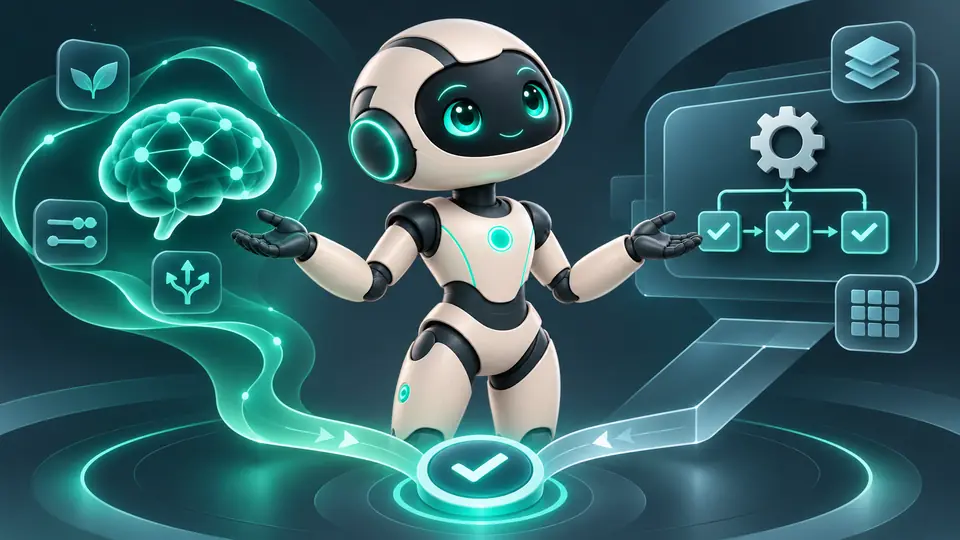
You might expect an AI systems architect to recommend AI whenever a business wants to improve something. But why should you pay for intelligence if a simple, reliable rule would do the job better?
I ask because every extra component costs something: money, maintenance, supervision, or somebody’s attention when it goes wrong. The question isn’t whether AI can do the task. It’s why your business would benefit from using it.
Take a customer request arriving through a business website. The form already contains the person’s contact details and what they need. The next step might simply be to acknowledge the request and assign it to the right employee. That doesn’t call for AI. It calls for a reliable process.
Now consider another request to the same business. This time, the customer sends a long email, describing several issues without making it clear which one needs attention first. Someone has to make sense of it before the work can move forward. AI might help summarize the message and identify missing information. That is a different kind of problem.
And if the request involves an urgent situation or a commitment the business must honor, somebody still needs to take responsibility for the decision. The point isn’t to give every step to AI. It’s to recognize why some steps need a predictable rule, others benefit from interpretation, and a few require human judgment.
Which parts of this work need intelligence, which need reliability, and which need a person?
Why I separate AI from ordinary automation
The difference matters because some tasks need a consistent action while others need someone, or something, to interpret unfamiliar information. I’d rather make that distinction than pay for intelligence at every step.
When following a rule is enough
Why is ordinary automation valuable? Because some work should not be surprising. When something predictable happens, the business wants a defined action, not a fresh opinion.
A form submission creates a contact. An approved invoice goes to accounting. A confirmed appointment triggers a reminder.
The advantage is not that these systems are clever. It’s that they do the same defined job consistently, assuming the inputs and integrations work.
When interpretation earns its place
AI earns its cost in different circumstances: when the information is messy, people describe things differently, or a draft needs interpretation. The point is not to make the workflow smarter everywhere. It’s to give the business flexibility exactly where rigid rules fall short.
A customer might describe a problem in fifty different ways. An AI system may help summarize those messages or identify the likely category.
But once that category has been reviewed and accepted, the next action may be an ordinary rule. Send it to this team. Assign this priority. Create this follow-up task.
You don’t need to ask AI to make that decision again if the business already has an approved rule for it.
An online school: where automation ends and judgment begins
In an online-school project, I worked through requirements for course access, students’ submissions, teacher feedback, and progress records. The challenge wasn’t finding one AI agent to manage everything. It was understanding which actions had to be dependable, which information might need interpretation, and which decisions belonged to teachers.
Consider a family purchasing a course. Once the payment is confirmed, the right student should receive access to the right lessons. That is a defined business rule. Asking an AI agent to decide what someone purchased would introduce uncertainty into a process that should be predictable.
Later, a student might upload a photograph of a project or submit a PDF for feedback. The school needs that work attached to the correct student and lesson, the teacher notified, and the history preserved if the student submits a revision. These are important tasks, but they don’t require a language model to invent what happens next.
Now suppose a parent sends a long message covering a missed lesson, questions about a workbook, and a delayed response from a teacher. AI might help organize those questions for a staff member to review. That’s where interpretation could save effort without deciding the answer on the school’s behalf.
Marking student work, giving educational feedback, and approving certificate-related decisions call for accountable human oversight. A plausible AI-generated response isn’t a substitute for a teacher’s judgment.
That’s why I would separate course-access rules, submission handling, optional AI assistance, and human decisions. The value isn’t an impressive all-purpose agent; it’s knowing who or what is responsible for each part. Those connections would still need testing before they could be considered reliable.
And that only becomes clear when we understand why the original process is failing and what the school actually needs to protect.
What if a parent calls instead?
The online school also has to consider people who call rather than write. Imagine a parent asking about lesson times, another wanting to discuss a teacher’s feedback, and a third reporting a concern that needs prompt attention. They may all reach the same phone number, but they don’t need the same response.
A straightforward answer or callback process may be enough for routine information. An AI receptionist could help with repetitive questions if its information is accurate and it knows when to hand over. But questions about an individual student’s progress or a sensitive concern need an appropriate person, not an improvised answer.
That’s the distinction I would protect: the caller should reach useful information or someone who can take responsibility. I’ve explored that decision in more detail in Do You Really Need an AI Receptionist?
When content moves from draft to publication
So far, the online-school example has been about information coming in: a purchase, a student submission, or a parent’s question. In a separate business project, the challenge ran in the opposite direction: getting content out. A draft that never reaches publication is no more useful than an inquiry that never reaches the right person. In both situations, the handoffs are where responsibilities matter.
For that business, I developed a content process with distinct stages for researching, writing, revising, repurposing, approving, and distributing material.
AI can be genuinely useful for developing ideas, writing drafts, adapting an approved article into a different format, and identifying places where the wording doesn’t fit the intended audience.
But I don’t want a language model deciding whether it feels like publishing on a particular platform today.
Once content is approved, a publishing system should follow defined rules: which account, which format, what schedule, and whether that specific item has authorization to go out.
That’s why I separated AI-assisted creation from rule-based publishing. The value isn’t merely a cleaner architecture. It’s knowing that an approved piece of content won’t be changed or released because a model decided to improvise.
There is still work involved in making integrations dependable, and individual platform behavior needs testing. I won’t pretend that a system is fully operational just because an AI model successfully wrote some captions.
But the architectural decision is deliberate. AI provides interpretation and generation where needed. Rules provide consistency where decisions have already been made.
The result is easier to supervise because I can ask different questions when something goes wrong.
Did the AI produce acceptable content? Did a person approve it? Did the publisher receive the right package? Did the platform confirm delivery?
Those shouldn’t be one vague question labeled “Did the AI work?”
Why the real fix may not need software at all
Take a creative agency where projects keep running late. You might hear “We need better automation” at every team meeting. But why are deadlines slipping? Are people waiting for approvals that were never clearly defined?
The team might suspect it needs a workflow platform that automatically assigns tasks, follows up, and summarizes progress.
Maybe. But what if every project starts without a clear definition of what the client must approve?
No automation can make that ambiguity disappear. It can only chase people more efficiently.
Or picture a local business where three employees are each responsible for “checking new inquiries.” The problem isn’t necessarily the software. It’s that the business has never decided who owns the follow-up.
A clear agreement about responsibility may be more valuable than another subscription.
I don’t see that as an anti-technology position. I see it as refusing to make technology responsible for problems it cannot solve.
Why every tool needs to earn its place
Before I recommend anything, I want to know what becomes better for the people using it. Otherwise the business could spend money optimizing a step that never mattered.
First, the value. What worthwhile result will improve for the customer or the team?
Then necessity. Does this task truly require interpretation, creativity, or judgment, or can it follow a reliable rule?
Reliability matters just as much. What happens when the system is wrong or unavailable?
So does total cost: subscriptions, usage fees, setup, reviews, maintenance, and the time employees spend correcting mistakes.
And finally, ownership. Can the business keep its information, understand its process, and replace a component without losing control?
That last point deserves attention whenever a new platform enters the picture. I discuss it in If You Cancel That Subscription Tomorrow, What Stops Working?.
Sometimes this comparison leads to AI. Sometimes it leads to automation. Sometimes it leads to both. And sometimes it leads to a much-needed decision about who should do what.
Why a convincing demonstration isn’t enough
A demo can make almost anything look effortless. But if you’re the one paying for the system, you need to know what happens during an ordinary Tuesday, with imperfect information and real customers waiting.
Suppose an AI assistant can summarize a hundred messages in minutes. That’s impressive, but it doesn’t tell me whether employees save time once they check those summaries.
Suppose a deterministic workflow sends every scheduled notification. That’s reassuring, but I still want to know whether the notification reaches the right person and triggers the intended action.
I would compare the practical result with the effort and cost required to get it.
Are errors becoming easier or harder to detect? Is a person still making the same corrections? Does the business understand what happens next?
This is why I think testing the whole workflow matters more than celebrating a successful AI call.
The smartest system is often a hybrid one
There’s a temptation to treat AI as the destination. Add more agents. Make everything conversational. Replace every rule with a prompt.
The reason I keep coming back to this distinction is simple: your business isn’t trying to become more artificial. It’s trying to serve people, avoid waste, and work reliably.
I want the flexibility of AI where language or uncertainty makes it valuable, the predictability of automation where the rules are clear, and human responsibility where the consequences deserve it.
I also want the business to be able to understand and own the arrangement.
Intelligent where it matters. Deterministic where it doesn’t. Owned by the business.
If you are wondering what your business genuinely needs, Explore the situations I write about or begin with the free AI & Automation Checkup.