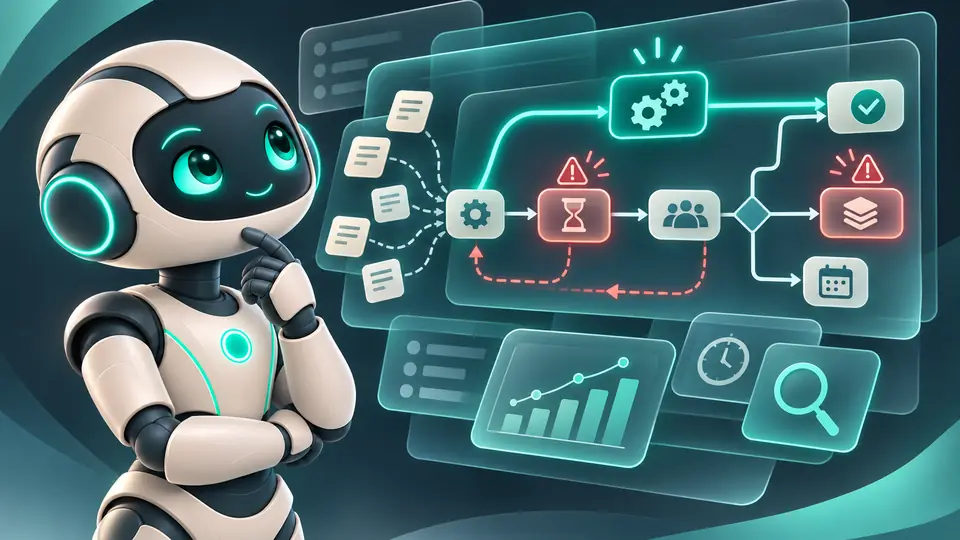
Have you ever received a confirmation that something was being handled, only to discover later that nobody had actually done anything? Imagine your customer experiencing that from your business.
Three days later, they call again. Why? Because knowing that a request exists isn’t the same as knowing who is responsible for it.
The dashboard can be perfectly up to date while the customer is still waiting.
That’s the frustrating part: everyone may believe the process worked. The request reached the system, yet the person who needed help is no closer to getting it.
When that happens, I don’t begin by asking which AI agent could automate more steps. I want to know why the work stopped between the first acknowledgment and the actual response.
Why isn’t the work getting done in the first place?
That question matters because the answer may be a missing owner, unclear information, an unrealistic expectation, or a process nobody understands. The fix might involve AI or automation, but only after we see the real cause.
Why the obvious problem isn’t always the real one
When work keeps slipping, the obvious explanation is often that there’s simply too much of it. But sometimes the volume isn’t the problem. It’s what happens to each request after it arrives.
When the request arrives but has no owner
Think about what happens if you report a maintenance issue to a property manager. Maybe you send an email, then a text, then call because nobody responds. From your side, it feels as though you have reported it three times. From the office’s side, it may appear as three unrelated messages.
It’s easy for the manager to conclude that the team needs an automated request system. But why are the requests overwhelming? Is it the volume, or the fact that nobody can confidently see which issue belongs to whom?
Possibly. But I would first ask what happens to a request after it arrives.
Does somebody know which property it concerns? Is the urgency clear? Who decides whether a contractor is needed? Who tells the tenant what to expect? And what confirms the work was completed?
If nobody owns that last part, automatically collecting requests only creates a more organized backlog.
When leads arrive but follow-up doesn’t
The same thing happens in marketing. A company believes it needs more leads because revenue is disappointing. Yet its CRM contains inquiries that were never called, proposals that were never followed up, and contacts nobody has been assigned to.
More advertising would put more prospects into the same neglected process.
I explore that wider pattern in What’s Making Your Business Harder Than It Needs to Be?. Sometimes the opportunity isn’t getting more work. It’s making better use of what already arrives.
A completed step isn’t necessarily a completed job
Take the unanswered inquiries sitting in that CRM. A prospect submits a form on the company’s website. The CRM creates a contact and notifies the team. Every automated step works exactly as intended. Yet the prospect is still waiting for a reply.
Why? Because the notification reaches a shared inbox, but no one has been made responsible for responding. Everyone can see the inquiry. Everyone assumes someone else will handle it. The problem isn’t that the system failed to collect the lead. It’s that the process stops just when a person needs to take over.
I wouldn’t start by adding an AI agent to this situation. I’d make sure each inquiry has a clear owner, that follow-up is expected within a reasonable time, and that unanswered requests don’t quietly disappear. Those simple decisions matter because a prospective customer needs a response, not another record in a database.
That’s the difference between completing an automated step and completing the job. Software can tell you an inquiry was received. What the business needs to know is whether somebody actually responded.
Sometimes the information is the problem
Other situations have nothing to do with motivation or ownership. The business simply doesn’t collect what people need to make the next decision.
Think of a small repair company. A request arrives saying, “My heater isn’t working.” That could mean several things, and the technician needs a few details before deciding what to do.
If those details are always collected through another phone call, the company is repeating the same discovery work every day.
A clearer intake form might help. So might a short acknowledgment asking for missing information. If messages arrive in unpredictable language and volume, AI might help categorize them for a person to review.
Notice how the technology choice changes once we know the real difficulty.
We didn’t begin with “install an AI receptionist.” We began with “make sure the right person has the right information.”
That is also why I ask whether a business truly needs an AI receptionist before recommending one. A reliable callback or routing rule can be more useful than a conversational system that still leaves the team guessing.
Why producing content isn’t the whole job
For one business, I developed a content-production system that brought the same problem into focus. A beautifully written draft is only useful if it passes review and reaches the right place. Why should “content created” count as success when nothing has been published?
At first glance, the ambition sounds straightforward: use AI to produce useful content more efficiently.
But writing, reviewing, repurposing, approving, scheduling, and publishing aren’t one job. They are connected jobs with very different requirements.
The project included tools for generating and refining articles, then separate processes for repurposing and publishing content. Each stage needed to know what it had received and what was supposed to happen next.
An AI draft isn’t an approved article. A finished social caption isn’t permission to publish it. A scheduled action isn’t proof that the platform accepted it.
When those distinctions are explicit, it’s easier to understand where a failure belongs. It also becomes much easier to decide when AI is useful and when a predictable rule is the better choice.
The project reinforced a simple principle: the technology matters less than whether responsibility is clear at every handoff.
Why responsibility comes before another AI agent
That was the key question in the content project: who decides when an article is ready to move forward? The same question applies to any business workflow. Adding another automated step won’t help if everyone can still assume someone else is responsible.
For a property manager, that could mean one reliable request intake path, a named owner, and clear escalation rules. For an agency, it could mean a visible review and approval stage before content is considered ready.
For a home-service company, it might be a better customer inquiry form and a callback responsibility. For an online business, it might mean reducing the number of places where an order status can be changed.
Those changes aren’t glamorous. They are useful because they make the work legible.
Only then would I ask whether the business needs a conventional automation, an AI component, a human decision, or some combination.
I explain that choice in AI or Automation? How to Choose the Right Tool for the Job. The important part is not adding intelligence to every step. It is using it only where judgment or interpretation genuinely helps.
Why the customer outcome matters more than the dashboard
If you were the person waiting for a repair or a callback, would you care that the notification fired? I wouldn’t call the system successful until the request reached a useful outcome, not merely another status.
For the maintenance request, I would look for fewer unassigned requests, clearer escalation, and confirmation that completed work is actually recorded.
For customer inquiries, I would want to see whether contacts receive a timely response, not just whether the CRM contains more records.
For publishing, I would distinguish approved material from queued material and queued material from content actually delivered.
I don’t need to invent an impressive percentage to make those checks worthwhile. What matters is whether we can see the work moving all the way to its intended outcome.
That difference is central to How to Know Whether Your AI Workflow Actually Works.
The most useful question is often the least technical one
You don’t need to know an API from an AI model to recognize that the same problem keeps happening. You probably know where people get annoyed. The question worth exploring is why they have to work around it.
They usually know exactly where the irritation appears. The hard part is discovering why.
Sometimes the real cause is hidden information. Sometimes it’s a missing handoff. Sometimes a person has too many decisions to make. And sometimes the system is performing the wrong task very efficiently.
I would rather identify one of those problems properly than build an elaborate solution around the wrong assumption.
Before you automate the process, make sure you know which part of it actually needs fixing.
If that question is difficult to answer, you can explore the other business questions or use my free AI & Automation Checkup to find a starting point.